
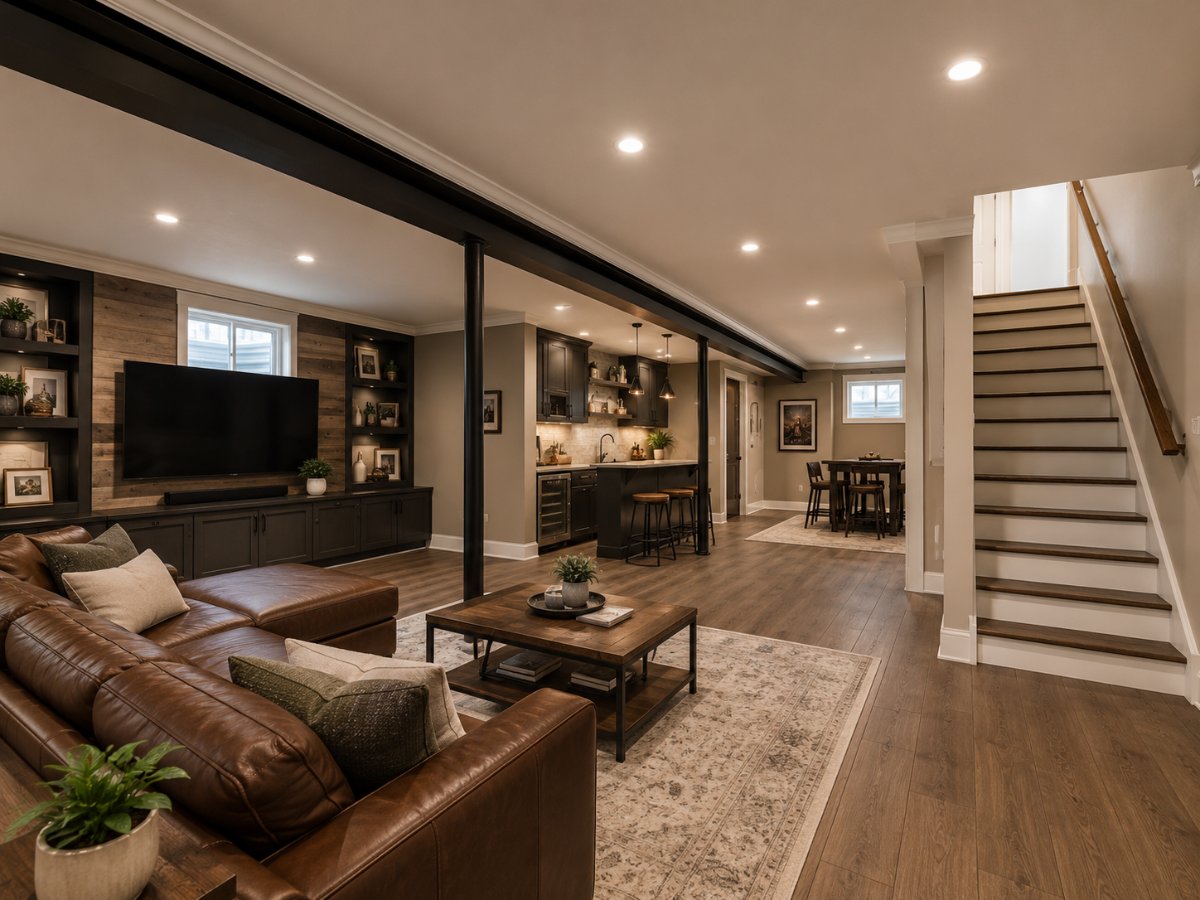
Does Finishing a Basement Add Value? A Boulder Homeowner's ROI Guide
It's the question behind every basement project: if I spend the money, do I get it back? The honest answer is that finishing a basement is one of the more reliable home improvements for building value — but the way it adds value surprises a lot of homeowners. Here's what the 2026 numbers actually say, how the per-square-foot math works, and the one appraisal rule that trips people up.
The short answer: A finished basement typically recoups about 70–75% of its cost at resale, and often more in a tight, high-value market like Boulder's. You won't usually get back every dollar — but you add living space far more cheaply than any other way, and you get the use of it for years before you ever sell.
How Much Will You Actually Recoup?
National remodeling data puts the average basement finish at roughly 70 to 75 percent of cost recovered at resale. The widely cited Cost vs. Value Report lands near 71%, and other industry surveys have measured returns into the 80s. So on a $50,000 finished basement, you might reasonably expect somewhere around $35,000 in added value — not the full $50,000.
That spread is wide on purpose, because the return depends on a few things: your local market, the scope of work (an open rec room returns differently than a real bedroom-plus-bathroom), the quality of the finish, and how long you stay before selling. The recoup figures assume a few years of ownership — if you finish a basement and list the house two months later, you generally won't see the full return.
Why Boulder Tilts Toward the High End
Location is the single biggest factor in basement ROI, and it works in Boulder's favor. In competitive markets where inventory is tight and every square foot commands a premium, finished basement space is genuinely scarce and valuable — so the recoup rate trends toward the upper end of the national range, and in the hottest pockets a well-executed finish can approach dollar-for-dollar.
Boulder is exactly that kind of market: high home values, limited supply, and buyers who expect usable, move-in-ready space. A finished basement here isn't an oddity — it's something a serious buyer is actively looking for.
The Per-Square-Foot Math: The Cheapest Space You Can Add
Here's the angle that often matters more than the recoup percentage. Finishing a basement uses square footage your home already has — the foundation, walls, and roof are already built. That makes it dramatically cheaper per square foot than any other way to add living space.
Finishing runs roughly $50 to $100 per square foot in the Boulder area (see our basement finishing cost guide), while building an addition commonly runs $200 to $400+ per square foot. You're buying livable square footage at a fraction of the price — which is why finishing consistently ranks among the most cost-efficient ways to expand a home.
The Catch Most Homeowners Miss: Below-Grade Value
This is the part worth understanding before you spend a dollar. Appraisers do not value a finished basement the same way they value the floors above it. Two rules drive this:
- It's discounted per square foot. Finished below-grade space is typically valued at only 50–70% of the per-square-foot value of above-grade rooms — even with identical floors, trim, and lighting.
- It's not counted in your "gross living area." By appraisal standards, below-grade square footage generally can't be added to the home's official GLA, no matter how beautifully it's finished. It's listed and valued separately on the appraisal.
The practical takeaway: a finished basement won't appraise like adding the same square footage upstairs. That's not a reason to skip it — it's a reason to budget realistically and finish to a quality and scope the market will actually reward, rather than over-spending as if it were an upstairs addition.
What Maximizes Your Return
Within that reality, these are the choices that push your number up:
- Permit the work. Unpermitted finished space is routinely excluded from appraised square footage and creates buyer-financing headaches. Permitted, on-the-record work is what counts — see our Boulder permit guide.
- Add a legitimate bedroom and bath. A code-compliant egress-window bedroom plus a full bathroom adds far more value than open square footage alone.
- Keep it open, neutral, and flexible. Broad-appeal layouts and finishes beat highly personalized, themed builds, which can actually lower resale appeal.
- Don't overbuild past the neighborhood ceiling. Spending for a luxury basement in a mid-market block rarely returns; match the finish level to your home and street.
- Consider an income suite. A basement apartment or ADU can generate rental income that pays the project back directly — a different and often faster route to return.
Equity Today, Not Just at Resale
Equity is simply your home's value minus what you owe on it. A finished basement raises your home's market value, so it builds equity the day the work is done — not only when you sell. And unlike a stock you can't touch, this is equity you live in: a guest suite, an office, a gym, a place for the family to spread out. For many Boulder homeowners staying put a few years, the daily use alone justifies the project well before resale ever enters the conversation.
So Is It Worth It?
If you're staying in your home for several years, finishing a basement is usually a clear win — you get strong everyday value plus a solid share of your investment back in equity. If you're finishing purely to sell soon, run the numbers carefully, keep the scope sensible and permitted, and lean on broad-appeal finishes.
Because the return depends so heavily on your specific home, block, and the current market, the smartest move before a resale-driven project is a quick conversation with a local real estate agent or appraiser about what finished basement space is bringing in your neighborhood right now. For the cost side of the equation, our Boulder cost guide breaks down what drives the price.
See what your basement could be worth
A free in-home estimate gives you real numbers for your space — cost, scope, and the finish level that makes sense for your home and neighborhood.
(720) 340-2032